The Future of Business: BDO Techtonic States 2025
The Future of Business: BDO Techtonic States 2025
Original content provided by
The business environment has changed beyond recognition in recent years. Geopolitical upheavals, economic turbulence, sharp rises in capital and energy prices, and accelerating technological development are changing the rules of the game. Companies must face not only more intense competition, but also new threats, particularly in the area of cybersecurity. According to the BDO Techtonic States 2025 – The New Business Edge study, every company is faced with the question: "How to become a resilient organization that can grow in times of uncertainty?" And according to 61% of the executives surveyed, resilience is the most valuable trait of a modern company.
Why is resilience the key to success?
- Resilience means more than just the ability to withstand short-term crises. It is the ability to anticipate future scenarios, adapt to rapid change, and use uncertainty as a source of opportunity. Technological innovation can be a huge catalyst for growth. Data, artificial intelligence, and modern digital tools enable companies not only to optimize processes, but also to discover new business models and respond agilely to changes in demand.
- At the same time, however, there are growing threats that are hampering development. Cyberattacks are becoming increasingly sophisticated, infrastructure in many companies is aging, and rising capital costs are slowing investment in innovation. As Rocco Galletto, global leader in cyber security at BDO, notes, the perception of risk has changed dramatically: "What was once considered a problem for large corporations now affects all businesses, regardless of their size."
Three pillars of new competitive advantage
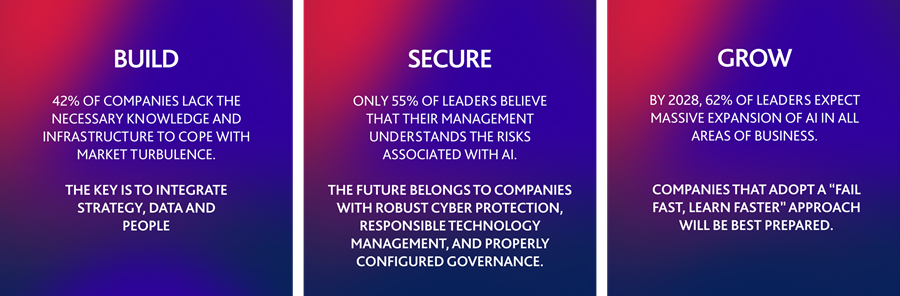
The study defines new competitive advantages as the ability to connect technology, data, and business strategy in order to gain a long-term competitive advantage for the organization. This approach is based on three pillars:
- Build: lay the foundations. Companies must first ensure that they have a high-quality infrastructure, an integrated data strategy, and employees who understand digital technologies.
- Secure: Ensure protection. Robust cybersecurity and responsible management of artificial intelligence are essential for maintaining customer and investor confidence.
- Grow: Growth. Success awaits those who are willing to experiment, learn quickly, and spread innovation throughout the enterprise.
Future development scenarios: four possible worlds by 2028
Based on a global survey of more than a thousand executives, BDO has identified four alternative scenarios for what the business world could look like in three years. These scenarios differ in two ways: the degree of technological development (whether artificial intelligence or humans dominate) and the nature of markets (cooperation vs. fragmentation).
WORLD SUSTAINED: A world of gradual, continued evolution
In this scenario, technological progress occurs, but its implementation is uneven and does not lead to dramatic productivity gains. International trade remains relatively open, although global growth is slow and unstable. Companies rely more on local supply chains and look for ways to minimize risk rather than pursuing aggressive expansion.
- Technological progress is rapid, but its implementation varies across markets and sectors.
- Global trade remains relatively open despite uncertainties, but global growth is slow and unstable.
- Companies are gradually shifting toward greater use of local sources for key products and services; multinational companies are focusing on minimizing risks in supply chains.
- Artificial intelligence and digital technology solutions are being implemented, but are not leading to significant productivity breakthroughs.
- Multilateral cooperation continues, but at a slower pace.
WORLD FRAGMENTED: A world defined by deeply fragmented markets and supply chains.
This scenario is characterized by chaos, shifting alliances, and growing protectionism. Trade rules are constantly changing, complicating planning and investment. Technological progress is stagnating, hampered by strict regulation and a shortage of key materials and talent. International expansion is risky, and success comes to those who can diversify and be as flexible as possible.
- The business environment is chaotic, with shifting alliances and open conflicts.
- Protectionism and market fragmentation are on the rise.
- Companies face constant unpredictability in operations and planning.
- For medium-sized companies, especially those with international activities, the situation is complex and unstable.
- Regulations, trade, and investment policies are difficult to comply with, and technological innovation is hampered by regulatory interventions and a shortage of critical materials and skills.
WORLD DIVIDED: A world defined by east-west bifurcation
The global economy is divided into two blocs with different technologies, standards, and regulations. The West and the East are competing for resources, talent, and data. Paradoxically, it is this rivalry that is accelerating the development of artificial intelligence and other advanced technologies. For Western companies, this may mean new opportunities in sectors that have so far been the domain of Chinese or Russian players, but also more complex conditions for global trade.
- The business world is divided into two economic models with different rules, technologies, and regulatory standards.
- Competition between these blocs concerns technology, key materials, skills, and data ownership. Supply chains are being restructured and major players are reorganizing.
- At the same time, intense rivalry between East and West is accelerating the development and deployment of technologies and the development of skills, leading to transformative technological leaps.
- Western medium-sized companies are finding new opportunities in industries previously dominated by Chinese companies.
WORLD ACCELERATED: A world defined by accelerated tech and aligned business networks
The most optimistic scenario predicts rapid development of artificial intelligence, data analysis, and digital ecosystems. Technology helps solve global challenges and increases productivity across all industries. International cooperation is strong, leading to rapid standardization and interconnection of innovative companies. Organizations that can keep pace have a chance to become leaders in the new digital era.
- The global economy is stable and capital costs are manageable.
- Technologies are being rapidly adopted, bringing significant productivity gains and transforming industries.
- Technologies play a key role in addressing global challenges and supporting innovation ecosystems.
- Artificial intelligence, data analytics, and data-driven services enable personalized products and rapid responses to demand.
- International standards are emerging that support technology development and build trust.
- Growing domestic and international cooperation is leading to better alignment in the use of technology.
How to prepare for an uncertain future?
- According to the study, one thing is certain: no company can afford to rely on just one scenario. 73% of executives believe that the key to success is to prepare for different future scenarios and be able to adapt quickly. This includes investing in a high-quality data strategy, modernizing IT infrastructure, developing cybersecurity, and intelligently diversifying supply chains.
- Artificial intelligence also plays an important role. Already, more than 60% of respondents consider it a key competitive advantage, with healthcare, education, and financial services leading the way in its use. However, for investments in artificial intelligence to deliver real results, they must be linked to clearly defined goals and business strategy.
BDO Techtonic States 2025 – The New Business Edge
The entire study is available for download via the link below:
Download